
Should You Switch Just Because Claude Fable 5.2 Is Here?
A new AI release can make the model you already use feel suddenly outdated. Bigger version numbers and longer score tables do not necessarily make choosing easier. If your daily work is editing notices or organizing information, is the most powerful model always the right fit?
Anthropic announced Claude Fable 5.2 and Mythos 5.2 on November 9. For an everyday user, the useful starting point is not the score table but which model the company recommends for which work. The announcement does not suggest moving every task to the newest model immediately.
The focus is on the hardest problems
Fable 5.2 targets difficult technical work without a straightforward answer. Anthropic describes improvements in coding, multi-step reasoning, and understanding visual information. A model is the part of an AI service that produces the answer, rather like the engine behind it.
That does not mean your own work will improve by the same amount. A company's evaluations and your tasks may involve different conditions. Shortening a sentence and working out why several documents disagree are not the same kind of problem.
Instead of focusing only on impressive demonstrations, think about work your existing tools still struggle to complete. There is little reason to complicate a workflow that already gives you satisfactory results.
Opus can still be the starting point for everyday work
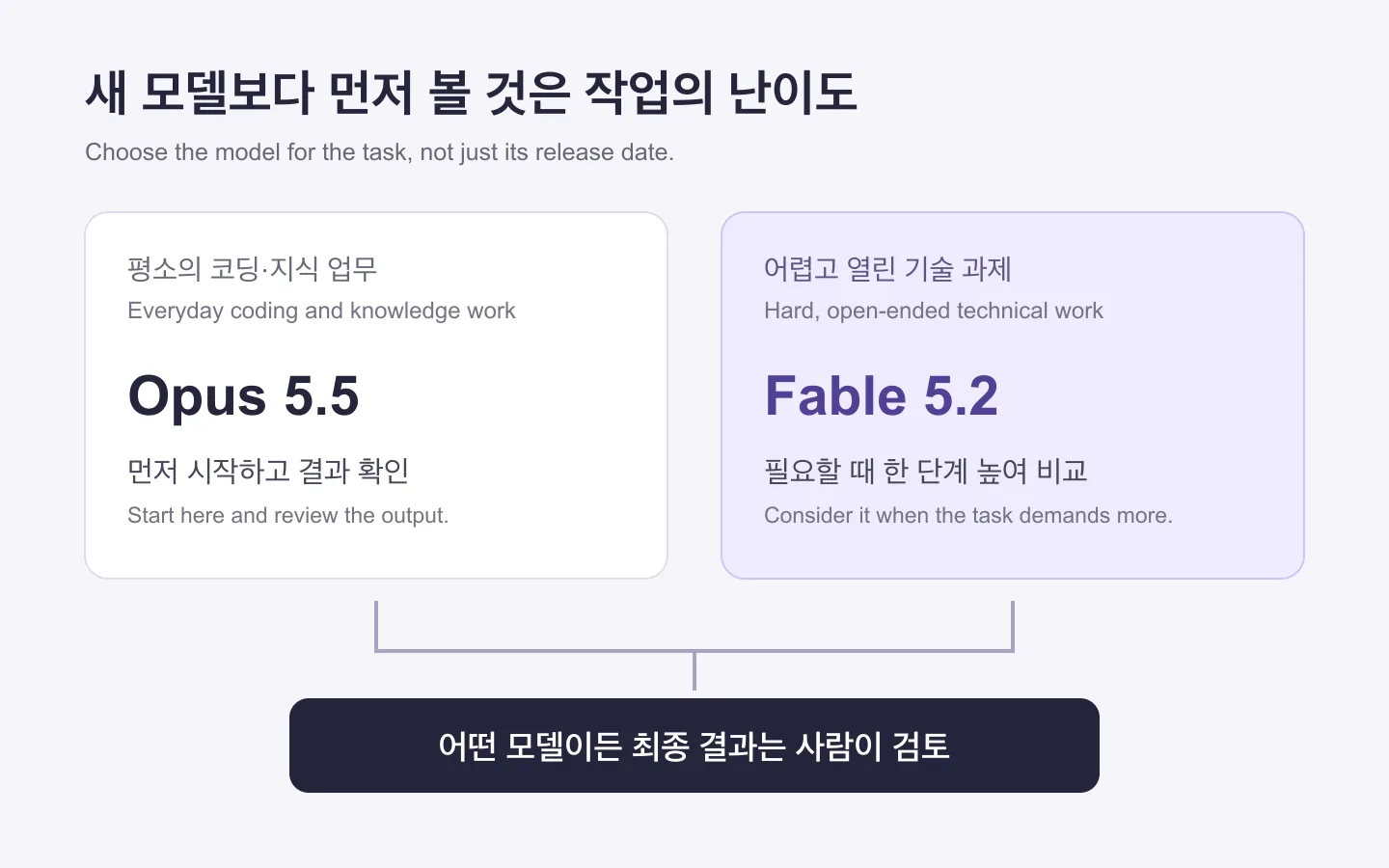
The official announcement recommends starting with Claude Opus 5.5 for most coding and knowledge tasks. Depending on the scope and difficulty, users can then consider Fable or Mythos for harder work, or adjust toward alternatives such as Sonnet and Haiku. That is different from recommending one newest model for everything.
You do not need a development background to apply this idea. Keep what already works, and compare alternatives where a task repeatedly gets stuck. Knowing where your work breaks down is more useful than memorizing every model name.
Rewriting a sentence and rethinking a problem are different
If a shop closure notice is too long, a clearer length and tone requirement may be enough. If three documents give conflicting conditions and you first need to determine which applies, the task requires more comparison and judgment. Calling both writing tasks hides that difference.
Do not switch models simply because one answer disappoints you. First check whether you provided the necessary information and a clear definition of done. Try alternatives when the same difficulty remains after that.
Fable and Mythos have different access conditions
Being announced together does not make these models interchangeable choices with identical access. Fable and Mythos share an underlying model, but Fable includes safeguards against misuse in cybersecurity and biology.
Access to Mythos 5.2 follows routes such as verification programs for cybersecurity and life-sciences organizations and designated enterprise security services. It should not be treated as a model an ordinary user can simply select under the same conditions.
Fable 5.2 is available through the Claude Platform and major cloud providers. Whether you can use it, what usage is included, and whether a launch promotion applies depend on plan and seat conditions. Availability does not establish free, unlimited access for every account.
Lower API rates are not a monthly subscription price
The announcement lists standard API rates of $8 per million input tokens and $40 per million output tokens. An API lets another program connect to AI, while tokens measure the content the model reads and writes. A token does not always correspond exactly to one character or word.
Those figures do not mean the Claude app's monthly subscription has changed to those amounts. Usage-based costs for connected software and a person's app subscription are different things to check. The optional faster-output mode also has separate pricing, so review the rate as well as the speed.
If you are not building a connected service, you do not need to calculate every API rate. Start with the models your own plan offers, its usage allowance, and any conditions for extra charges. Do not assume the price in an announcement is the price on your billing screen.
Make one small comparison using your own kind of work
If you are considering a switch, choose a small task without personal information. Use invented sample material to compare answers instead of beginning with real customer records or an important contract.
- Give each model the same material and definition of done. Extra context for only one makes comparison difficult.
- Look for missed conditions, unsupported certainty, and numerical mistakes rather than length or polished language.
- Include the effort of reviewing and fixing the output. An impressive first answer may still create more work for you.
For an event-planning notice, for example, provide a budget, schedule, audience, and conditions that cannot change. Ask for missing requirements to be identified. Judge whether the conditions were followed, not how impressive the language sounds.
Start with the difficulty in your work, not the model name
Fable 5.2 adds an option for difficult problems. It need not be treated as a signal to change everyone's everyday workflow immediately. The official guidance itself points toward matching the model to the difficulty of the task.
Keep what works and compare alternatives where you get stuck. Knowing which conditions get missed and which errors recur in your work is a better starting point than following every new name. Whichever model you choose, checking the final result still matters.
- #AI
- #Claude
- #Fable 5.2
- #Opus 5.5
- #AI Workflows
More posts
Browser Automation Made Easier: What Aside and Ego Change
From Gemini, Claude, and Comet to Aside and ego lite: understand AI browser automation, practical tasks, and safer first steps without a coding background.
"Pacing the Frontier": Why Sam Altman and Dario Amodei Agreed to Slow Down AI
The global technology landscape is experiencing a paradigm shift that few saw coming just months ago. Led by Anthropic CEO Dario Amodei and OpenAI CEO Sam Altma…
Six Things That Must Stay in Your Name When Someone Else Builds Your Website
Nobody thinks about it while the site is running fine. It surfaces the day you part ways with whoever built it. Domain, DNS, deployment, source code, analytics, licences — here is how to check, in five minutes, that all six are in your name.