
ChatGPT's healthcare update does not replace your clinician
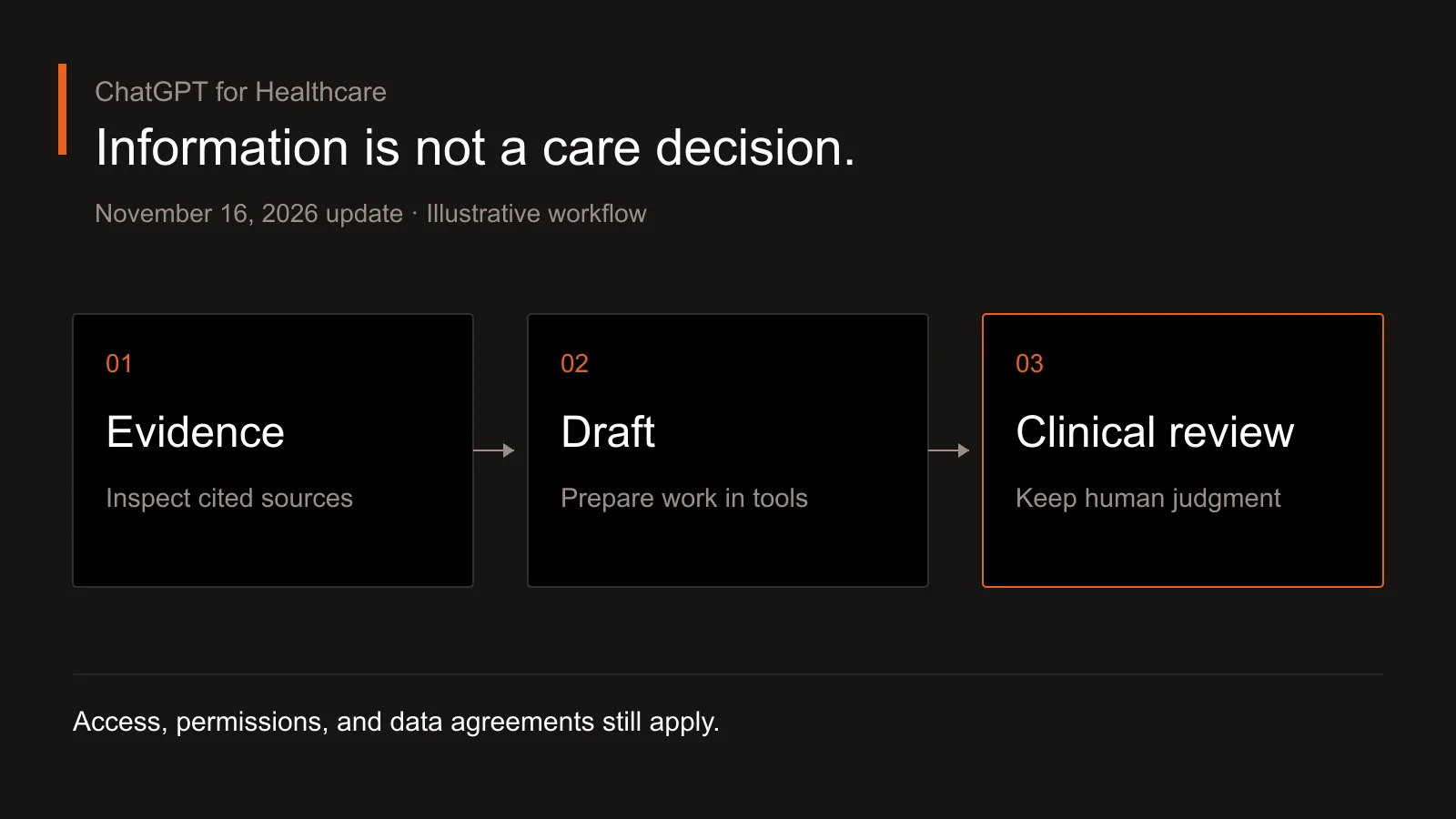
News that medical AI can operate hospital software raises an understandable question. Can you now upload test results to ordinary ChatGPT and let it handle your care? The key distinction is that finding evidence, preparing work, and making care decisions are different tasks. Support for clinicians should not be mistaken for an automated personal medical service.
The update reaches beyond answering a question
On November 16, 2026, OpenAI announced an expansion of ChatGPT for Healthcare. It improved clinical search that finds and cites medical evidence, introduced more than 20 new healthcare plugins, and described computer-use capabilities. A plugin connects ChatGPT to information or functions supplied by another service.
Finding evidence and operating software are different
Search retrieves evidence from sources such as papers and guidelines. Connected tools provide access to permitted information and functions in external services. Computer use lets AI read screens, click, type, and carry work across applications. Being able to operate an interface does not automatically grant access to every record or permission to perform every action.
Consider work that starts with reviewing a patient record and continues with preparing information in another system. OpenAI's MRI demonstration used synthetic patient data, not a real patient's case. The AI reviewed records and prepared an MRI order, an encounter note, a patient reply, and a prior-authorization request, with review by a clinician and an authorization specialist. The demonstration should not be read as a patient outcome or proof of performance in every hospital.
Separate ordinary accounts from healthcare access
ChatGPT for Healthcare is a governed workspace for clinical, research, and administrative teams. According to the announcement, existing customers could access computer use in Work and Codex and improved clinical search on the announcement date, subject to workspace settings. New healthcare plugins also need administrator enablement. This does not mean every feature automatically appears in a personal account.
Free access has a US clinician eligibility condition
The individual product, ChatGPT for Clinicians, is free for eligible, verified clinicians in the United States. Enrollment requires a ChatGPT account, a valid NPI, and a license that can be verified, among other conditions. An NPI is a US healthcare provider identifier. Readers should not assume that a general user in Korea, or a clinician with only a Korean license, can enroll on the same terms.
Select plugins are available in Clinicians. Which tools appear and can be connected depends on the plan, workspace, region, and the service's own requirements. Announcing more than 20 tools is therefore different from making all of them usable in your account. An organization considering adoption should first identify the work and connected services it needs, then check access conditions with its administrator.
Citations do not remove the need for review
The official help page states that Clinicians supports rather than replaces professional judgment. Clinicians remain responsible for care decisions and should independently verify information as appropriate. Even when an answer links to a paper or guideline, the source and its applicability need review. A well-organized draft is not the same as an appropriate decision for a particular patient.
For a team evaluating these tools, a useful starting point is a small, verifiable task rather than handing over an entire care process. Decide which information it may read, which work must remain a draft, and who checks it before the next step. These are suggested evaluation questions. This article did not connect a live medical system, test the workflow, or measure time savings.
No model training does not mean unrestricted data sharing
OpenAI says content shared with Healthcare and Clinicians is not used to train its models. That is not permission to put patient information anywhere. Handling identifiable health information requires checking the BAA covering eligible services, required security and retention settings, and organizational authorization. A BAA is an agreement addressing US health-information obligations. It should not be treated as blanket clearance for every legal requirement in Korea.
External connected services also need appropriate permissions and agreements. In particular, the apps that search public healthcare data in Clinicians do not retrieve patient charts. The official help page says not to include patient names, medical record numbers, or other identifying health information in those public searches. A search tool and a workspace authorized to handle patient information are not interchangeable.
The meaningful change is a broader set of tools for clinicians to connect evidence review with administrative work. For a general reader, the accurate way to interpret the news is not as immediately available automated care, but through three checks: who can use it, what data may be shared, and where human review remains.
- #AI
- #ChatGPT
- #Healthcare AI
- #Privacy
More posts
Claude Meetings beta and what outside guests can see
Before inviting Claude to a call, check consent, chat visibility, Team and Enterprise settings, saved records and connected-tool costs.
Gemini 4 Hydrogen access is not the same as model selection
Free access to Gemini 4 Hydrogen has a condition. Learn how automatic selection differs from choosing a model, and what to check before using it for documents.
ChatGPT Wallet approval does not mean an order is confirmed
Who can use ChatGPT Wallet, how biometric approval works, and why approval is not an order confirmation. Check the merchant’s result before retrying a purchase.